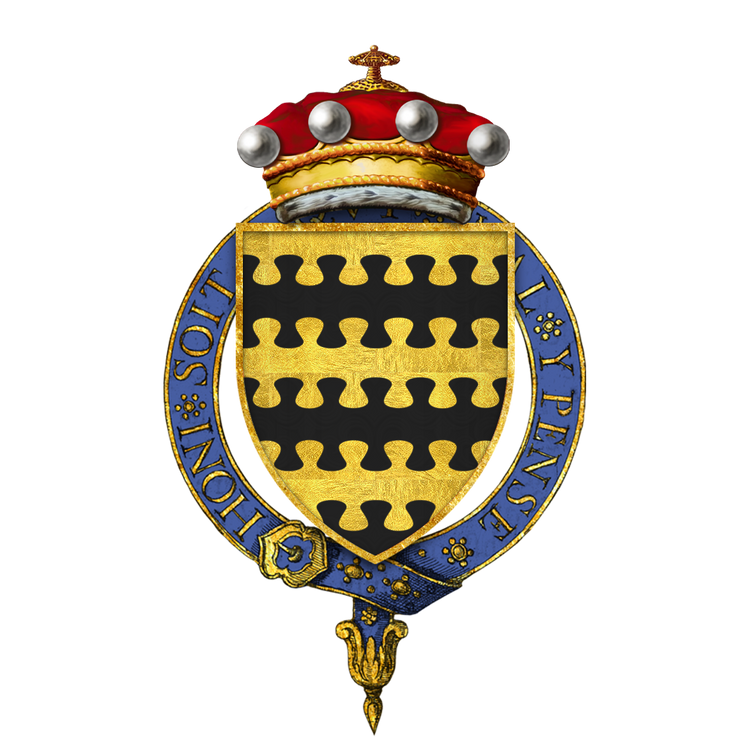
William Blount, 4th Baron Mountjoy (c. 1478–8 November 1534), was one of the foremost courtiers and humanist nobles of early Tudor England, notable as Henry VIII’s boyhood tutor, a close associate of Erasmus, and a powerful office-holder at the heart of the Henrician court and its religious politics.
He combined military service, high financial and administrative office, and cultural patronage, becoming one of the wealthiest and most influential English nobles of his generation.
Origins, family and early life
William Blount was born around 1478 at Barton Blount, Derbyshire, the eldest son of John Blount, 3rd Baron Mountjoy, and Lora Berkeley, and inherited the barony as a minor on his father’s death in 1485.
His family were long-established Midlands gentry and peers, giving him both landed wealth and an established route into royal service.
He married four times, forging alliances with both traditional nobility and London mercantile wealth: first Elizabeth Say, then Alice Keble (daughter of Henry Keble, Lord Mayor of London), then the Spanish gentlewoman Ines de Benegas, and finally Dorothy Grey.
These marriages produced several children and helped consolidate his social position, with descendants remaining in the peerage networks of the 16th century.
Humanist education and patronage
Mountjoy was educated in the new Renaissance humanist fashion and became a pupil and patron of Desiderius Erasmus, who famously described him as “inter nobiles doctissimus” – “the most learned among nobles.”
Mountjoy first met Erasmus in Paris in 1498, invited him to England in 1499, and maintained a warm intellectual friendship with him for decades, exchanging visits and correspondence.
He moved in the leading English humanist circle, counting John Colet, Thomas More and William Grocyn among his friends.
As a patron, he provided financial and social support that allowed Erasmus and other scholars to work and publish, helping to embed humanist learning at the English court and in the universities.
Military and political career under Henry VII
Under Henry VII, Mountjoy was already prominent in royal service.
In 1497 he held a command in the royal forces that suppressed the Cornish rebellion associated with the pretender Perkin Warbeck, demonstrating his reliability in defence of the Tudor regime.
He was present with Henry VII at Calais in 1500 and witnessed the marriage of Prince Arthur and Catherine of Aragon, placing him close to the centre of dynastic and diplomatic affairs.
By the end of Henry VII’s reign he sat on the king’s council and was sufficiently favoured that Henry VII is recorded as visiting him in 1508, evidence of his status as a trusted noble councillor.
Tutor and mentor to Henry VIII
Mountjoy’s most enduring influence lay in his role in the education of the future Henry VIII.
After Erasmus returned with him to England, Mountjoy helped organise and personally contribute to the young prince’s humanist education, serving as Henry’s tutor and companion.
Through Mountjoy, Henry was exposed early to Erasmus’s writings, to Thomas More, and to the broader culture of humanist scholarship, chivalric ideals and courtly behaviour.
This formative influence supported the intellectually curious, Latin-literate, theologically engaged king Henry would become, even if Henry later broke with many of the ideals espoused by his early humanist mentors.
High offices: Mint, Tournai and the royal household
At Henry VIII’s accession in 1509, Mountjoy’s standing translated into major administrative responsibility when he was appointed Master of the Mint, a key financial post overseeing coinage at a time when royal fiscal strength was central to foreign and domestic policy.
In 1512 he was made Chamberlain to Queen Catherine of Aragon, placing him at the head of her household and at the intersection of the king’s domestic, dynastic and diplomatic concerns.
In 1513 he was appointed Governor of the captured town of Tournai (in modern Belgium), where he ruled from 1513 to 1519 and conducted vigorous civil and military administration.
His detailed letters to Cardinal Wolsey and Henry VIII from Tournai, which survive in the British Library and British Museum, show him as an energetic, technically capable governor dealing with finance, fortifications and local politics in an occupied continental city.
At the heart of Tudor statecraft
Mountjoy remained close to Henry VIII in the great diplomatic theatre of the 1520s.
He attended Henry at the spectacular Field of the Cloth of Gold in 1520, the summit with Francis I of France, and also at the 1522 meeting with Charles V, Holy Roman Emperor.
His presence at these events reflects his status among the inner circle of high nobility trusted to accompany the king on major diplomatic ventures.
He was also created a Knight of the Garter, the crown’s highest order of chivalry, further confirming his rank as one of the premier noble courtiers of his day.
Contemporary and later accounts repeatedly note that he was among the most powerful and possibly the richest English noblemen at court during his lifetime.
Role in Henry VIII’s “Great Matter”
Mountjoy’s office as Chamberlain to Catherine of Aragon placed him in a uniquely painful position when Henry sought to annul his marriage.
It fell to Mountjoy to inform Catherine that Henry intended to divorce her and, later, to convey to her the humiliating demotion from queen to “Princess Dowager.”
In 1530 he joined other nobles and churchmen in signing the letter to Pope Clement VII which threatened that Henry would repudiate papal supremacy if the annulment was not granted, aligning him publicly with the king’s policy even as it undermined the queen whose household he served.
Sources suggest that, though he remained formally in favour and was never disgraced, he gradually withdrew from the very centre of court life during the turbulence of the break with Rome.
Character, reputation and death
Contemporaries and later writers remembered Mountjoy above all as a cultured nobleman who fused aristocratic power with Renaissance learning.
Erasmus’s praise, his friendships with leading humanists, and his patronage of scholarship and the arts gave him an international reputation in intellectual circles.
He died on 8 November 1534 at Sutton-on-the-Hill in Derbyshire, survived by his fourth wife, Dorothy Grey, and succeeded in the barony by his son.
To historians of the Tudor period he stands as a key intermediary figure: a noble commander under Henry VII, a tutor and cultural mentor to the young Henry VIII, a senior office-holder in the early Henrician state, and a humanist patron whose life tracks the shift from late-medieval court culture into the conflicted politics of the English Reformation.