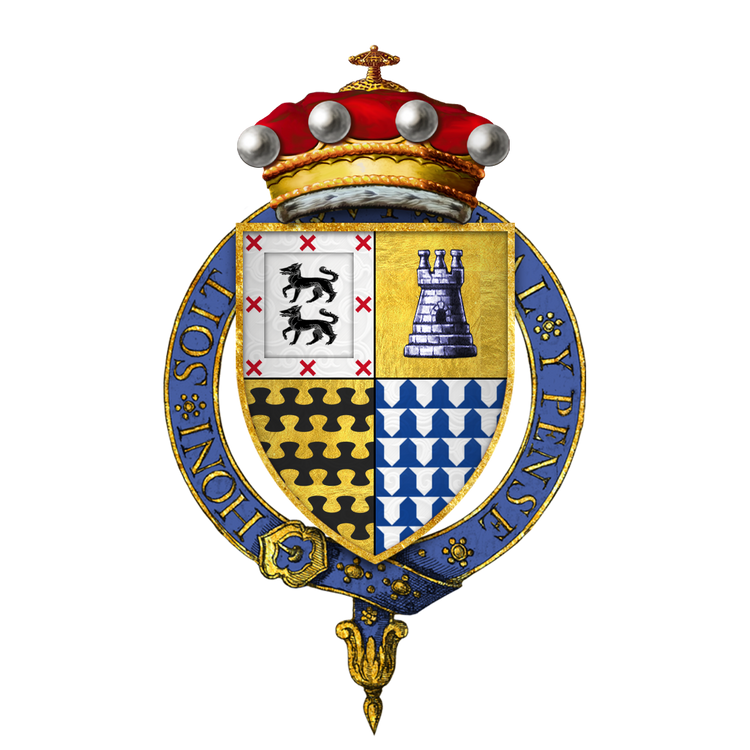
Walter Blount was the first member of the family to receive a peerage, created Baron Mountjoy in June 1465 by Edward IV – the barony deriving its name not from any territory but from the ancient Mountjoy marriage two generations before, a rare and notable distinction in English peerage history. A key figure in the politics of the Wars of the Roses, he transferred his allegiance decisively from Lancaster to York in 1454 and was rewarded with high office, vast estates and a royal marriage.
Knight of the Garter, Lord High Treasurer of England, and Governor of Calais, he raised the Blount family from the leading gentry to the peerage, establishing the dynasty at Barton Blount and Elvaston in the full dignity of late-medieval nobility.
Origins and early life
Born about 1416, the eldest son of Sir Thomas Blount of Elvaston and Margery Gresley, and grandson of Sir Walter Blount of Shrewsbury, he entered the household of Henry VI around 1440 – a natural continuation of his family’s three generations of Lancastrian service.
The transfer to York: the sack of Elvaston, 1454
The decisive moment in Blount’s political evolution came on 28 May 1454, when Sir Nicholas Longford of Longford led a band of some thousand men in an armed raid on Blount’s manor of Elvaston. Longford’s men reportedly quartered tapestries bearing the Blount arms, justifying their action with the accusation that Blount ‘was gone to serve Traytours’ – meaning that he had attached himself to the Duke of York, who had become Protector two months earlier when Henry VI became mentally incapacitated.
Whatever the prior degree of his Yorkist sympathies, the sack of Elvaston drove Blount firmly into the Yorkist camp. Through the late 1450s he served Richard Neville, Earl of Warwick, as marshal at Calais, and when civil war broke out in 1459 he took the Yorkist side. At the decisive Battle of Towton, in March 1461, he fought for Edward IV and was knighted on the field.
Royal favour and high office
Blount’s support for the Yorkist cause brought rapid rewards. He became Steward of the High Peak in Derbyshire and the dominant figure in Derbyshire parliamentary politics, sitting repeatedly as Knight of the Shire. He succeeded his father as Treasurer of Calais in 1460 and became Governor of Calais in 1461, the most important English outpost in continental Europe.
His marriage to Anne Neville, the wealthy dowager Duchess of Buckingham and aunt of the Earl of Warwick, was a spectacular social elevation thought to have been facilitated by royal patronage; she was one of the richest widows in England. In 1467 Edward IV conferred on him rich estates in Devon forfeited by the attainted Earl of Devon, greatly extending his landed income.
In June 1465 Blount was created Lord High Treasurer of England and simultaneously raised to the peerage as Baron Mountjoy. The creation is historically notable as one of the very earliest baronial titles that was neither territorial in character nor the revival of an existing dignity; the title commemorated the Mountjoy blood that had entered the family through the marriage of Sir John Blount of Sodington to Isolda Mountjoy more than a century before. He was installed as a Knight of the Garter in April 1472.
The crises of 1469–71
In the great crisis of Edward IV’s reign, sparked by the King’s alienation from Warwick between 1469 and 1471, Blount equivocated briefly before firmly committing himself to Edward, and fought in the victorious royal campaign of spring 1471. His eldest son and heir, William Blount, was killed at the Battle of Barnet on 14 April 1471. William’s death meant that, when Walter Blount himself died on 1 August 1474 at the Greyfriars, London, the barony passed not to a son but to his underage grandson, Edward Blount, as 2nd Baron Mountjoy. He was buried in the Chapel of the Apostles in the church of the Greyfriars.
Marriages and children
By his first wife, Helena Byron, daughter of John Byron of Clayton, Lancashire, he had four sons and two daughters: William (killed at Barnet, 1471), John (later 3rd Baron Mountjoy), James (who supported Henry Tudor and lived until 1492), Edward, Anne and Elizabeth. By his second wife, Anne Neville, widow of the 1st Duke of Buckingham, married by November 1467, he had no known surviving issue. The year of his birth (c. 1416, occasionally given as c. 1420) is an approximation.