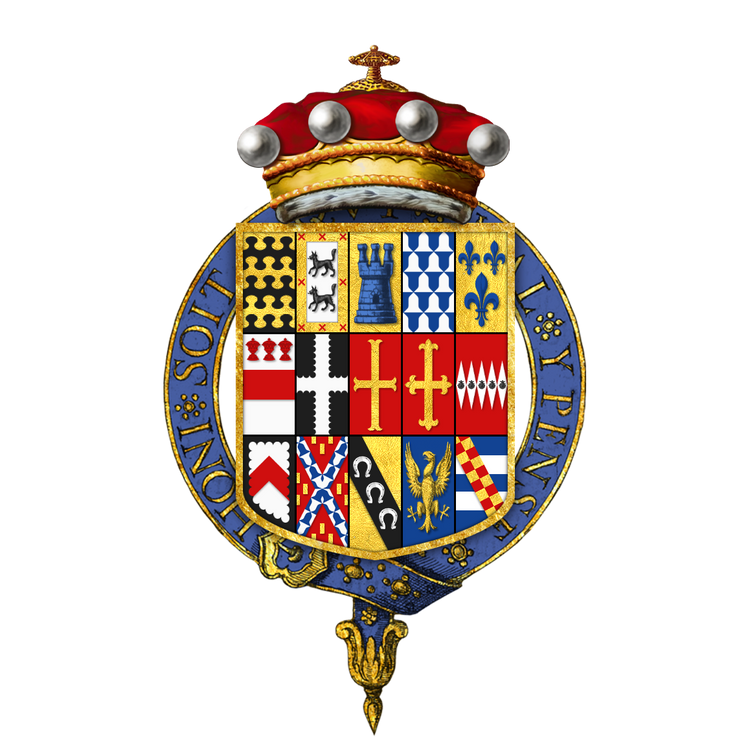
Charles Blount, 8th Baron Mountjoy and 1st Earl of Devonshire, was the most distinguished soldier and one of the most consequential figures of the Elizabethan age – the man who, against considerable odds, ended the Nine Years’ War in Ireland, defeated the Spanish at the siege of Kinsale, and received the submission of Hugh O’Neill, Earl of Tyrone, six days after the death of Elizabeth I. His career combined exceptional military ability with a courtier’s finesse and a scholar’s serious intellectual engagement.
His private life – a long liaison with Lady Penelope Rich, sister of the Earl of Essex, and a final controversial marriage to her following her ecclesiastical divorce – ended in royal disgrace under James I. He died in April 1606, his legitimate titles extinct, leaving his considerable fortune to his illegitimate children.
Origins and early career
Charles Blount was born in 1563, the second son of James Blount, 6th Baron Mountjoy, and Catherine Leigh. He studied briefly at Oxford, then at one of the Inns of Court. When his father died, the barony passed to his elder brother William; Charles was left with small independent means and a burning desire, later inscribed on a boyhood portrait, to rebuild his family’s house – ad reædificandam antiquam domum.
Introduced to court around 1583, he made an immediate impression on Queen Elizabeth, arousing the jealousy of Robert Devereux, 2nd Earl of Essex, who remarked of a token the Queen had given Blount, ‘Now I perceive every fool must have a favour.’ A duel near Marybone Park followed, in which Essex was wounded; the two men subsequently became close friends. Blount sat as Member of Parliament for St Ives and later for Bere Alston, served in the Netherlands under Leicester from 1586, and was knighted there in 1587 after sustaining a wound.
Military career to 1600
Between 1586 and 1598 Blount served extensively on the continent – in the Netherlands, in Brittany, and in the Armada campaign of 1588 in Essex’s squadron – and joined Essex and Sir Walter Raleigh in the Azores expedition of 1597. He succeeded as 8th Baron Mountjoy on the death of his brother William in 1594, and in 1597 was created Knight of the Garter.
Ireland: the Nine Years’ War
The defining achievement of Blount’s life was the resolution of the Nine Years’ War in Ireland (1593–1603), which had defied all previous English commanders. After Essex’s catastrophic failure as Lord Deputy, Blount was appointed Lord Deputy on 24 February 1600 and approached the task with systematic intelligence: he cleared and garrisoned the Moyry Pass, dispatched Sir Henry Docwra to establish a fort commanding Lough Foyle in Ulster, set up posts at Mountnorris and Armagh, and pursued a policy of destroying the corn harvest to induce famine in rebel-held areas.
The crisis came in the autumn of 1601 when a Spanish force of some 3,400 men landed at Kinsale, County Cork, under Don Juan del Águila, and Hugh O’Neill marched south to join them. Mountjoy besieged the Spanish while turning to face O’Neill’s advancing army, and at the Battle of Kinsale on 24 December 1601 the combined Irish and Spanish forces were defeated; the Spanish capitulated shortly afterwards. By the summer of 1602 Mountjoy had advanced into Tyrone, destroying O’Neill’s strongholds and the inauguration site at Tullyhogue. On 30 March 1603 – six days after the death of Elizabeth I, which Mountjoy concealed during the final negotiations – O’Neill signed the Treaty of Mellifont, ending the war.
Earl of Devonshire
On his return to England, Blount served as one of Sir Walter Raleigh’s judges in 1603. In the same year King James I appointed him Master of the Ordnance and created him Earl of Devonshire, granting him extensive estates. Camden described him as ‘a person famous for conduct, and so eminent in courage and learning that in these respects he had no superior, and but few equals’. Mountjoy Castle in County Tyrone, built by Blount in 1602, and Charlemont Fort, which he named after himself, preserve his name in Ireland to this day.
Penelope Rich and the final disgrace
From about 1590 Blount had been in a relationship with Lady Penelope Rich (née Devereux), sister of the Earl of Essex and generally identified as the ‘Stella’ of Philip Sidney’s Astrophil and Stella. She was the unhappily married wife of Robert Rich, 3rd Baron Rich, and their liaison produced five children. After Lord Rich obtained a formal ecclesiastical divorce in November 1605, Blount married Penelope at Wanstead House on 26 December 1605, in a ceremony conducted by his chaplain William Laud, later Archbishop of Canterbury – in defiance of canon law. The marriage was immediately condemned by James I, who banished both parties from court, and their children remained illegitimate.
Charles Blount died of pneumonia on 3 April 1606 at Savoy House, London. His hereditary titles – the barony of Mountjoy and the earldom of Devonshire – became extinct at his death, and he was buried in St Paul’s Chapel at Westminster Abbey on 7 May 1606. His eldest natural son by Lady Rich, Mountjoy Blount, was later created Earl of Newport. The estate record follows the consensus birth year of 1563; the date of 1562 occasionally appears in older accounts.